
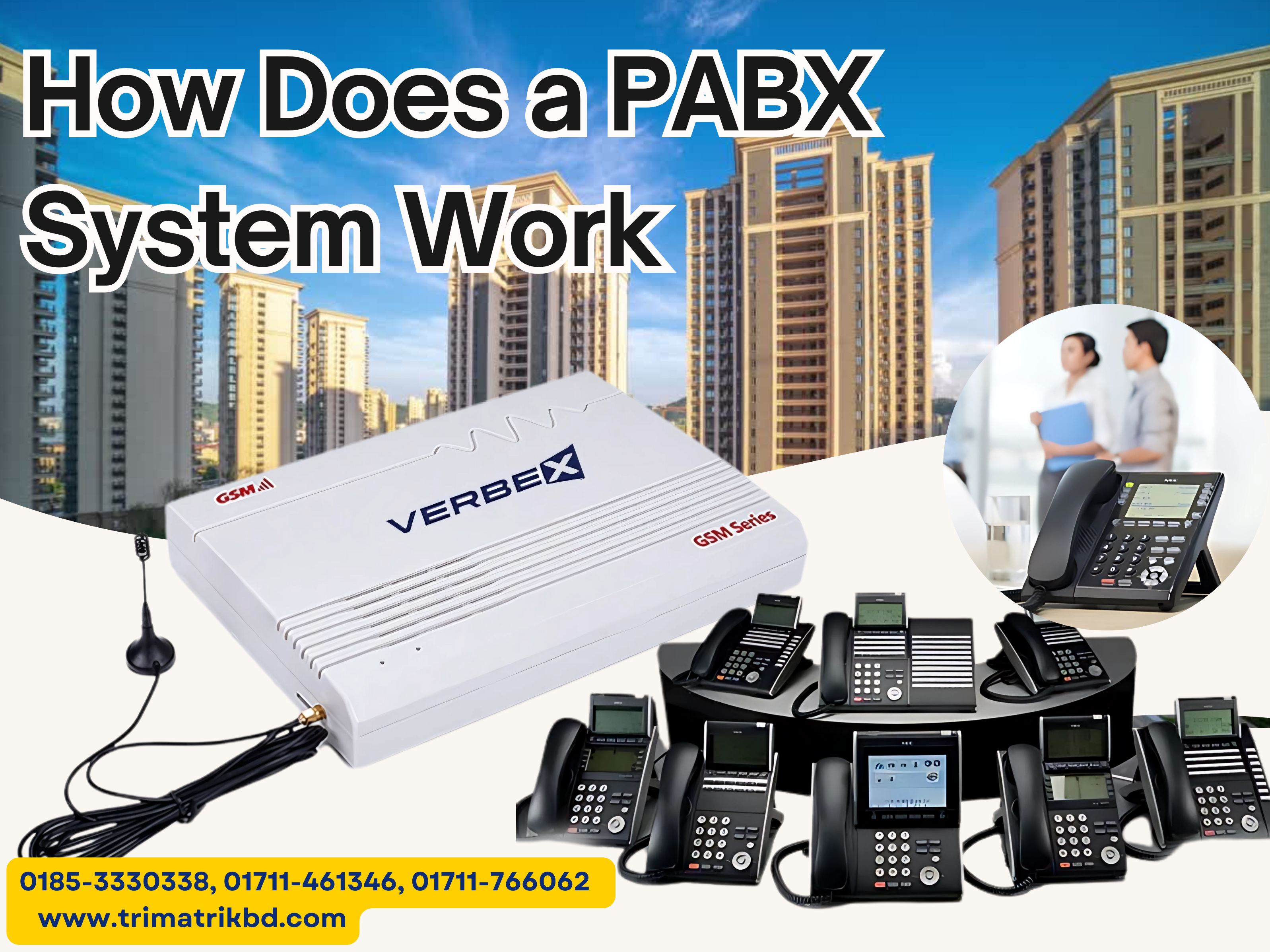
What is PABX system?
A PABX system (Private Automatic Branch Exchange) is a telephone system used within an organization to manage internal and external communication. It allows businesses to connect internal phone lines to each other, as well as to external telephone lines (such as public telephone networks). The system automatically manages these connections without the need for manual intervention from an operator. In the PABX system there are some plots by which more than 10 telephone sets can be connected in the organization.
Types of PABX system?
There are several types of PABX (Private Automatic Branch Exchange) systems, each suited to different business needs and technological environments. The main types of PABX systems are:
1. Analog PABX
- Description: The traditional PABX system, where telephone lines and switches are purely analog. This type of system uses standard telephone lines to connect internal extensions to external phone lines.
- Features:
- Limited features compared to modern systems.
- Requires separate physical lines for each extension.
- Less flexible and scalable.
- Use Case: Typically found in small businesses or older installations that do not require advanced features like VoIP integration.
2. Digital PABX
- Description: A more advanced system than analog, using digital signals to carry phone calls. Digital PABXs use digital transmission methods (such as ISDN or proprietary digital protocols) to connect calls.
- Features:
- Improved call quality and reliability over analog systems.
- Better support for features like call routing, call forwarding, voicemail, and conference calling.
- Digital lines can support more extensions with fewer physical lines.
- Use Case: Medium-sized businesses that need better call quality and more advanced features but do not yet require VoIP integration.
3. IP PABX (Internet Protocol PABX)
- Description: Also known as VoIP (Voice over Internet Protocol) PABX, it uses the internet (or any IP network) to handle voice calls rather than traditional telephone lines. Calls are transmitted as data packets over the network.
- Features:
- Significantly lower cost for both local and international calls, especially for larger businesses.
- Flexibility in adding extensions, as IP phones can be connected via the internet (no need for dedicated phone lines).
- Integrated with other business systems like CRM, email, and collaboration tools.
- Scalable with minimal infrastructure changes.
- Often comes with features like unified communications, video conferencing, and mobile app integration.
- Use Case: Suitable for businesses of all sizes, especially those looking for cost-effective and scalable solutions with modern features.
4. Hosted PABX (Cloud PABX)
- Description: A cloud-based phone system where the PABX is hosted and maintained by a third-party provider. The phone system is accessible via the internet, and businesses do not need to invest in on-premise hardware.
- Features:
- No need for onsite equipment or maintenance; the provider handles everything.
- Often includes advanced features such as call analytics, voicemail-to-email, call forwarding, and mobile app integration.
- Scalable and flexible based on business needs.
- Lower upfront costs, as it operates on a subscription or pay-as-you-go model.
- Use Case: Ideal for businesses that need a low-maintenance solution, especially small and medium-sized companies that prefer outsourcing their infrastructure.
5. Hybrid PABX
- Description: Combines traditional analog/digital PABX systems with IP capabilities. It allows businesses to integrate existing analog or digital lines with IP-based systems, providing a bridge between legacy and modern communication technologies.
- Features:
- Allows businesses to transition gradually from traditional telephony to IP-based systems without abandoning their existing infrastructure.
- Supports both VoIP and traditional phone lines.
- Flexible in terms of scalability and future upgrades.
- Use Case: Businesses that have a significant investment in analog or digital phone systems but want to gradually adopt VoIP features.
6. Virtual PABX
- Description: A system where the PBX service is provided virtually through software applications. These systems typically run on standard computers or cloud infrastructure and offer all the same functionalities as a traditional PABX.
- Features:
- All features of a traditional PABX but without the need for dedicated hardware.
- Often provided as a software service (SaaS) and operated via web interfaces.
- Can integrate with other software systems, such as CRMs and email.
- Use Case: Ideal for businesses that require a software-based, highly flexible, and cost-efficient telephony solution.
Use of PABX in office
A PABX system (Private Automatic Branch Exchange) plays a critical role in enhancing communication within an office environment. It helps streamline both internal and external communication, and its features can greatly improve efficiency, reduce costs, and offer advanced management options. Employees in an office can communicate with each other using internal extensions. Instead of dialing external phone numbers, employees dial short extension numbers to reach colleagues. This reduces the need for external lines and keeps internal communication cost-free.The PABX system allows office employees to make and receive calls from external lines (public telephone network or mobile phones) using the same system. Calls from internal extensions can be routed through a limited number of external lines, meaning the office doesn’t need a separate external line for each employee.PABX systems often include voicemail services, which allow callers to leave messages when employees are unavailable. Voicemails can be accessed remotely, and some systems offer voicemail-to-email features, sending voice messages directly to a user’s email inbox.
Use of PABX in apartment
A PABX system (Private Automatic Branch Exchange) can also be used in apartment buildings to facilitate communication among residents, staff, and external callers. While the use of PABX in residential settings is not as widespread as in businesses, it offers several benefits for managing internal communication, improving security, and providing convenience.
Importance of PABX in our daily life
The PABX system (Private Automatic Branch Exchange) plays a vital role in facilitating communication in many environments, from businesses to apartment buildings, and even personal and daily life contexts. While we often take the technology for granted, it has numerous benefits that impact how we communicate both professionally and personally
What is the price of PABX in Bangladesh?
There’s many types of PABX in Bangladesh and their price is also different. Recently, the price of PABX in Bangladesh has been determined according to size, quality, brand, type, extension line and feature. It could be a minimum 5,500 taka and the maximum rate is 30,000.
In conclusion, a PABX system is a cost-effective and efficient telecommunication solution for businesses, offering features like free internal calls, advanced call management, scalability, and easy integration with modern communication tools. It enhances productivity by improving call handling, supporting remote work, and providing detailed analytics. With the transition to cloud and IP-based systems, PABX continues to evolve, offering businesses greater flexibility, mobility, and reliability while reducing operational costs. Overall, PABX remains a critical asset for modern organizations looking to streamline communication and improve customer service. Even in personal or small business settings, PABX can provide significant advantages in managing calls, reducing costs, and improving convenience. For larger organizations, the system’s advanced features like call routing, voicemail, conferencing, and integration with other software make it an indispensable tool for smooth, reliable, and cost-effective communication in modern life.
Table of Contents
